
When talking about dryers, people usually think of convection dryers because this type of machine has many advantages in terms of drying quality and cost savings. However, few people understand the in-depth principles of convection, so in this short article, Mactech will analyze this issue to help readers understand it better.

All of Mactech’s current multi-purpose (heat drying) dryers use convection drying because this is the most optimal principle for controlling temperature in a hot drying chamber, ensuring uniform temperature distribution throughout. Convection is the natural movement of hot air within a given space; this is a natural phenomenon, so convection temperature control takes advantage of this. However, to achieve uniform temperature in the drying chamber, it is necessary to combine convection and circulation temperature control.
Recirculation involves reusing all or most of the existing airflow within the drying chamber, as the pre-heated airflow provides a stable and efficient environment. This allows for better, easier, and more precise control of temperature uniformity throughout the machine.

Convection refers to the arrangement of airflow within the machine in an upward direction. Therefore, typically, the air blown from Mactech dryers comes from both sides, with air vents distributed from top to bottom at varying densities to ensure uniform airflow pressure. Mactech’s hot air dryers all have air intake vents at the top and air outlets on both sides, creating a continuous, circulating, and convection airflow. Therefore, a standard convection dryer always has upward airflow.
Convection drying is suitable for common, basic products such as drying bamboo shoots, banana seeds, vegetables, common medicinal herbs, leaves, branches, fish, shrimp, powder, sliced fruits, etc., and is widely used in both domestic and industrial drying applications. High-temperature dryers are all convection dryers with temperature control up to 300°C, suitable for drying electronic components, plastics, mica, transformers, metals, paint materials, etc.
Thus, through the basic information above, readers have gained a better understanding of convection dryers, their principles, and advantages. For further advice on other types of machines with various sizes and scales, please contact Mactech for more information. Thank you for learning about our products.
Most viewed content
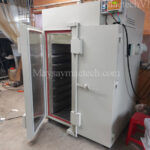 热风循环干燥机,干燥蔬菜、水果、药材,干燥温度35~95℃
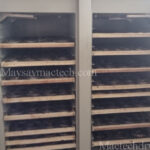 Dried snake dryer, drying all kinds of snake, refer to actual snake drying
 Drying process for Food, learning about drying parameter in accordance
 VIETNAM HAIR COMPANY, producing wigs, uses MSD1000-160
 Beef jerky dryer, drying beef in large pieces and shredding
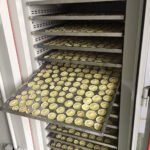 Dried lemons, which drying method is most effective?
 Celina detox fruit tea, weight loss tea, good for health
 Bao Lien dried lotus seed, refer to the lotus seed production facility
 Soybean sprout dryer, drying equipment for cereal grains
 Product images of hot drying for fruits, vegetables, dried meat, materials