
Roses are arguably the most widely used flowers, not only in the production of rose water and rose essence, but also in many other fields. Because of these different uses, the methods for drying roses also vary. Drying roses requires preserving their color and nutrients, while drying them to maintain their shape requires different drying machines to achieve the desired results.

The image above shows dried roses processed in a cold dryer at a temperature of 20-30 degrees Celsius. The dried flowers retain their natural color, fragrance, and nutrients; however, their shape will shrink somewhat. This type of dried product is widely used because it only requires dried flowers, which are beautiful, retain nutrients, and can be used in many common ways, such as making rose tea, infusing roses into other products, making rose bath water, and making rose powder. The method of drying roses as described above uses dry air at low temperatures to dry the product, preserving the natural properties of the flowers. The freeze-drying chamber is completely sealed, ensuring that the fragrance is not diminished. Compared to other drying methods, freeze-drying preserves the natural scent of the product best.
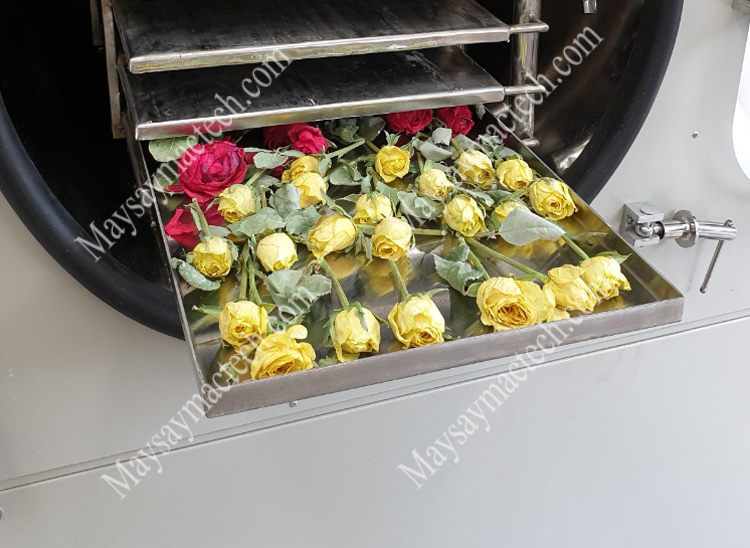
For higher quality dried roses, specifically preserving their natural shape, freeze-drying is the best method. Freeze-drying, also known as sublimation drying, ensures that the shape is preserved, preventing shrinkage, deformation, and color loss, while also maintaining the nutritional value of the product. However, this method of drying roses to maintain high quality is typically used for decoration, gifts, or combining with other flowers to create unique items. Therefore, the product’s cost is relatively high, limiting its applications.
Freeze-drying is suitable for all types of flowers such as roses, jasmine, chrysanthemums, camellias, green tea leaves, rose buds, etc. It is also suitable for drying soft, high-value fruits like durian, avocado, kiwi, strawberries, or precious medicinal herbs such as cordyceps, shiitake mushrooms, termite mushrooms, and seafood mushrooms. In particular, freeze-drying is the only way to achieve the desired quality for drying liquids such as extracts, probiotics, fine powder solutions, and fruit juices.
With the basic information on how to dry roses as described above, readers have a better understanding of the drying methods suitable for their needs. Customers who need more information about drying machines should contact Mactech for more detailed advice. Thank you for reading this information.
Most viewed content
 Xuan Huong Dried Beef, dried product from Mactech hot air dryer
 Viet Anh Company, uses 30kg freeze dryer to dry probiotics
 Freeze dryer, drying equipment that keeps original shape and color
 PARKER PROCESSING COMPANY, uses MSD1000-160 dryer
 Industrial food dryers, equipment suitable for private production.
 Soft dried product dryer, suitable for drying fruits, flower, herb
 Soft dried fruit, you need to know drying parameter and suitable dryer
 Electronic component dryer, drying for industrial part and materials
 Dried shrimp dryer, suitable for small and medium scale, fast drying
 Huong Thuy Lotus tea , refer to drying tea marinated with lotus