
Customers should note that for high-quality grains, the drying and crisping stages of the grain must be ensured; not all grains can be dried to achieve the desired crispness. Therefore, a thorough understanding of grain production will lead to higher-quality products that can be easily preserved for a longer period. In this article, Mactech will discuss the differences between drying and roasting grains.

Many people often ask how quickly grain drying is done, and how many minutes it takes to complete a batch. This depends on the quality of the raw materials, that is, the quality of the grains before they are put into the dryer. What does quality mean here? It refers to the dryness and porosity of the grains. Depending on whether the grains are for immediate consumption or for grinding into fine powder, the quality of the grains before drying will vary. Most grains have low hardness, such as macadamia nuts, almonds, cashews, walnuts, peanuts, etc., and can be dried and cooked after harvesting. Some grains with high hardness, such as soybeans, black beans, red beans, etc., require additional soaking and boiling to create porosity before drying for immediate consumption, followed by crisp drying. Using a specialized grain dryer offers many suitable drying modes for different types of grains.

The purpose of drying is to ensure that the entire inside of the grain reaches the necessary dryness (moisture content < 10%) for long-term storage. For crisping, a short drying time at high temperatures (100-150°C) is sufficient for immediate consumption or grinding into flour. If the grain has high moisture content and is dried immediately at high temperatures for a short time, it will still be crispy and fragrant, but in the long run, the grain is prone to mold because the dryness in the core is not yet guaranteed. Therefore, the drying stage to remove excess water is performed before moving on to the crisping stage. Similar to making fried dough sticks (quẩy) for pho, if you only fry them until crispy, they will remain crispy for a few hours before becoming soggy and soft. Many fried dough stick manufacturers now use drying machines after frying, thus maintaining the crispness for many days when stored in airtight bags.
If the nuts are not dry enough, are still damp, or are still fresh, using a high-temperature dryer with multi-stage drying capabilities will help users reduce drying time and meet the required drying standards. Drying first and then crisping are essential steps. Drying at low temperatures (50-80°C) for 3-8 hours, and crisping at high temperatures (100-150°C, depending on the type of nut) for a shorter time (30-60 minutes). Drying time and temperature also depend on the properties of each nut. Nuts with high oil content, such as macadamia, walnuts, and almonds, should not be dried at excessively high temperatures; 100-110°C is suitable to prevent the kernels from turning yellow. Nuts with low oil content, such as soybeans, black beans, and mung beans, can be dried at temperatures up to 130°C.
These are the basic details about drying and roasting grains to help readers better understand this product. For further advice or to request a trial drying service, please contact Mactech. Thank you for reading this information.
Most viewed content
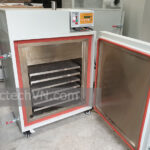 300 degree celsius industrial dryer, you can choose suitable dryer
 MSD200 Hot Air Dryer, circulation drying, suitable for drying 20kg material
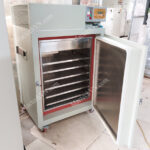 The 200 liter component drying cabinet, temp of 100 – 200 or 300 degrees
 Medicon Company, uses 8 MSD1500 dryers for medical supplies
 Chocolate drying, dryer suitable for small-scale production
 Crispy dried strawberries, How are their shape and color preserved?
 Pomely Karose grapefruit perfume, learn the production facility
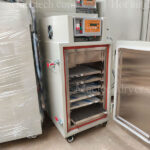 MSD100-160 industrial dryer, temp 35~160, used for civil and industrial
 Freeze drying process include which steps, learn about drying parameter
 Soft dried fruit, you need to know drying parameter and suitable dryer