
When we talk about crispy dried fruit products, we often think of popular items on the market like crispy bananas, crispy jackfruit, crispy sweet potatoes, crispy potatoes, etc., but in reality, these are fried fruits, not dried ones. To distinguish between fried and dried, we need to understand their nature and characteristic features for easy identification.

Most fruits contain a large amount of sugar, so using only conventional drying machines (hot and cold drying) will not produce a crispy product, except for some fruits with low sugar and high fiber content like apples, pears, oranges, and lemons. However, fruits like bananas, jackfruit, mangoes, pineapples, dragon fruit, durian, and strawberries cannot be dried to a crispy texture with an attractive shape. Therefore, some products that need to be dried to a crispy texture, such as crispy bananas, crispy jackfruit, and crispy sweet potatoes, are usually deep-fried. Using a deep-frying machine is cheaper and faster, while freeze-drying machine requires a long time, from 20 to 30 hours. Many crispy dried fruit products on the market are labeled as deep-dried or cold-dried, but this is not always the case. We need to know how to distinguish between naturally dried and deep-fried products.

Before delving into the distinguishing characteristics of crispy dried and fried fruit products, we need to understand the principles of drying and frying. Drying is a process that uses only heat and air dryness to evaporate the water in the product, while frying uses frying oil (cooking oil or animal fat) to make the product crispy. For fruits, frying in a vacuum environment is necessary to ensure crispness, but this requires high temperatures.
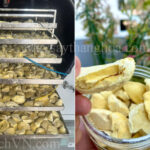
For most fruits currently available, the best method for achieving crispness and preserving natural characteristics requires freeze-drying (also known as freeze-drying). Products are quickly and completely frozen at -30°C. The drying chamber is vacuumed before the drying process begins, and the temperature is gradually increased from -30°C to 30°C or lower depending on the product. Therefore, freeze-dried products retain their original shape, color, and nutrients almost completely. However, the cost is higher, making them more difficult to sell. Freeze-drying is usually only suitable for special, high-value products such as ripe mangoes, strawberries, kiwis, durians, camellias, roses, rose buds, probiotics, cordyceps mushrooms, and spirulina powder. Crispy dried fruits have a powdery texture that crumbles easily when squeezed, retaining their original aroma and sweetness, or even becoming sweeter.
In contrast to drying, deep-frying involves high-temperature frying in oil. This process reduces the color and nutritional value of the product, and diminishes the sweetness of fruits due to sugar degradation at high temperatures. While the dried fruit may be crispy, its quality is inferior, and consuming it in large quantities can even be harmful. The frying oil, although extracted using a centrifuge, is not completely removed. When eaten, a sticky layer of oil clings to the hands; the fruit is crispy but firm, not powdery, and lacks aroma and sweetness. Deep-frying machines are only suitable for certain common products such as crispy bananas, crispy jackfruit, crispy sweet potatoes, and potatoes, and for making crispy fried snacks.
Based on the analysis of the two methods of making crispy dried fruit above, we now know how to easily distinguish between crispy dried fruit and crispy fried fruit. Frying alters the natural properties of the product, while freeze-drying preserves its natural characteristics. Customers are encouraged to contact Mactech directly for more detailed advice. Thank you for reading this information.
Most viewed content
 Thanh Hung dried durian, high quality crispy dried durian product
 MSL3000 heat pump dryer, drying about 300kg fruit, vegetable, herb, nut
 Highland Rhum cordyceps mushroom, refer to small facility
 Dried ginger dryer, drying temp 35 – 95oC, to meet drying from 10-500kg
 Loc Nhien cereal – Loc Nhien Natural, using MSD500-160 dryer
 The 100 liter component drying cabinet, temp 100 – 200 – 300 degrees
 Duyen Hai Seafood Company, the dried sea cucumbers for export
 Mini heat dryers, 10kg and 20kg, suitable for small-scale production
 Hoang Huynh Cooperative, Bac Kan, a model for production cooperatives
 Multi-function food dryer, suitable for drying a variety of products