
Kiwi is an expensive fruit, so crispy dried kiwi products need to have an attractive shape, color, and high quality to ensure a suitable price on the market. However, common drying methods currently available do not guarantee quality for soft, sugary, and watery fruits like this. Therefore, customers need to choose a drying method that ensures high quality for kiwi.
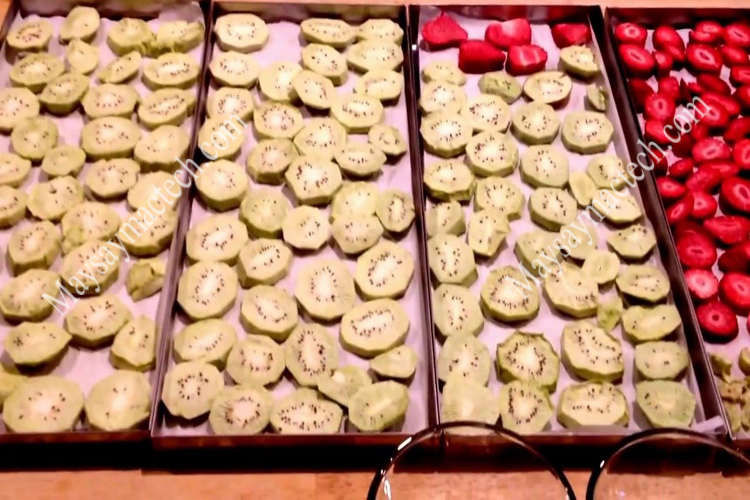
Kiwi fruit shares common characteristics with other familiar fruits like durian, custard apple, tomato, dragon fruit, watermelon, and mango. Soft, sugary, and watery fruits differ significantly from vegetables and fruits with lower sugar, lower water content, and higher fiber content when it comes to drying. Conventional drying methods, including heat and cold dryers, can only achieve a crispy texture for vegetables, herbs, sugar-free or low-sugar products, and some fruits like apples, oranges, and lemons. However, fruits with high sugar content can only be dried to a chewy texture, such as chewy bananas, chewy jackfruit, chewy dried dragon fruit, chewy dried pineapple, etc. So, what is the most effective method for producing crispy dried kiwi, crispy dried avocado, crispy dried mango, etc.?
The appropriate drying method for producing crispy dried kiwi is freeze-drying machine (also known as freeze-drying), a drying principle different from hot and cold drying. Freeze-drying completely freezes the water content in the product, followed by the sublimation of the ice into vapor under sufficient vacuum pressure in the drying chamber. In developed countries, freeze-drying has become very common, not only in industrial production but also in households. In Vietnam, this equipment is still relatively new and will need more time to become widespread in small-scale production.
Freeze-drying, Soft, easily deformed fruits like watermelon, dragon fruit, durian, kiwi, strawberries, etc., can all be processed into crispy, powdered dried fruit products. The product retains its original cut, size, natural color, and nutritional value. The drying process does not use any additives, resulting in high-quality, safe products for consumers.

With the above analysis of crispy dried kiwi, readers now know the appropriate drying method for sugary, watery, and soft fruits to obtain a crispy, naturally sweet, and fragrant product, even making a fine powder. Please contact Mactech for more advice. Thank you for reading this information.
Most viewed content
 MSD200-160 industrial dryer, temp 35~160, used for civil and industrial
 160 degree celsius component dryer, learn about many the different dryer
 Convection hot air dryers, How do they work?
 Turmeric starch dryer, quick drying, ensure turmeric starch quality
 The oriental medicine dryer, suitable for drying many types of herbs
 Nguyen An Bird Nest in Soc Trang, using a 3kg freeze dryer
 Cuu Long Oriental Medicine Production Facility, dry cordyceps mushrooms
 200 degree celsius component dryer, used in industrial fields
 Dried shrimp dryer, suitable for small and medium scale, fast drying
 Drying seaweed for instant consumption, Which drying method ?