
When it comes to crispy dried vegetables or simply dried vegetables, readers may not have used them often, but high-quality dried vegetables are actually very popular worldwide. While we may use them sparingly, many fields require dried vegetable products due to their numerous advantages, such as making vegetable powder, food coloring, nutritional vegetable powder, and mixed dried vegetables. In this article, we will explore the most effective methods and the resulting drying quality.
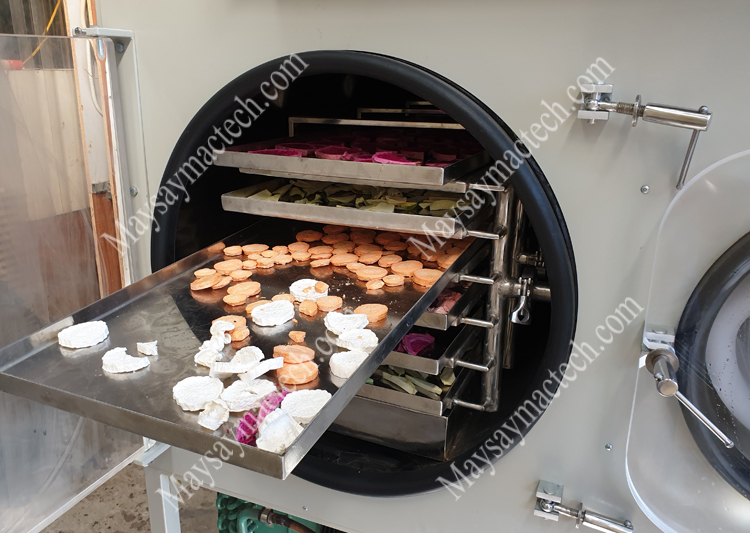
The essential characteristics of crispy dried vegetables are preserving as much of their original shape, maintaining their natural color as possible, and retaining their nutritional value. However, each drying method currently available allows for a certain level of product quality, corresponding to different types of dryers ranging from low-end to high-end, from inexpensive to expensive, and from common to complex drying principles. Currently available dryers include thermal dryers, heat pump dryers, and freeze dryers – these are the most common drying devices. Let’s explore each type to understand the characteristics of the dried product.
Freeze dryers are currently the most advanced drying equipment, allowing for the production of crispy dried vegetables with superior advantages such as retaining their shape, color, and nutrients almost 100% compared to fresh produce. The key to this drying method lies in the principle of ice sublimation; the product is rapidly frozen at -30°C for a sufficient amount of time, followed by sublimation when the drying chamber pressure reaches the necessary vacuum level. The resulting product is always dry, crispy, and powdery; it crumbles easily when lightly squeezed, making it very suitable for drying vegetables for powdering. Another name for this equipment is freeze dryer, as many people still call it. These dryers are very expensive, so they may not be effective for ordinary vegetables.
Heat pump dryers, a lower-end device, dry fruits and vegetables at low temperatures from 10-50°C and under normal pressure. Therefore, the dried products will shrink slightly, lose color only minimally, and retain their nutritional value. Cold-dried and heat pump-dried fruits and vegetables are also high-value products on the market today. This drying method is very suitable and effective because dried fruits and vegetables are not high-value products, so this method yields the best results while still ensuring crispness.
Compared to the other two types of dryers, the convection dryer is arguably the lowest-grade but most widely used because it is suitable for most products that need drying today, from fruits and vegetables to food and medicinal herbs. Products that only need drying, without requiring preservation of shape or color, and needing to ensure dryness and nutrient retention – such as dried bamboo shoots, dried meat, dried fish, dried vegetables, dried fruit, dried agricultural products, and dried medicinal plants – are common products that only require convection drying.
In summary, the above information has helped readers better understand the characteristics of crispy dried vegetables produced using different drying methods. Customers are encouraged to contact Mactech for more detailed advice on specific products and suitable drying machines. Thank you for reading this information.
Most viewed content
 Butter drying temperature, refer to some butter drying methods
 Crispy dried peanut dryer, learn about how to dry peanuts ready to eat
 Lim Farm and Food in Nghe An, produces the vegetable powders
 3kg Home fruit dryer, crispy drying of fruits and vegetables
 Bamboo shoot dryer, Dries quickly, resulting in a beautiful color
 Moc Truly Hue Company, produces ginger jam and teas
 Ba Ba Garden dried fruits, a southern Vietnam specialty product
 Vuon Ba Ba Company, specializes in producing soft dried fruits
 Drying process for Fruit, learn about drying parameter in accordance
 Winter melon tea dryer, produce the herbal tea from vegetable